Science Vodcasts

Where Our Visitors Come From

Wednesday, December 15, 2010

Seismic Wave Websites
Seismic Waves -- Follow the directions to complete the activities with this link. Be sure to read the page, try the wave machine, answer the questions, and check your answers. Additionally, you should click in the box that has an image of 4 cartoon houses on the Earth.
Seismic Waves 2 -- Scroll down until you find the PROCEDURE heading. Use page 10 of your packet for directions and hints to complete this activity.
Thursday, December 9, 2010
Exemplary Prezis
The Weathering and Erosion prezis that I have seen have been quite amazing. Here are a few that I felt were exemplary. Excellent job, Crazy 8s!
Tuesday, December 7, 2010
The Formation of our Black Hills
Many of you have been out to the Black Hills. If you haven't (or if you can't remember what it is like), visualize the following scenario:
As you drive west from Rapid City, you notice a jagged stretch of sandstone peaks called the Hogback Ridge. After a short descent from those sandtone peaks, you come to an area comprised of another sedimentary rock, red shale, which makes a "Racetrack" around the Black Hills. If you keep driving west, there is a gradual incline made of limestone. This limestone formed 100-500 million years ago, from the shells of ancient marine animals. (Yes, we are still in the Black Hills of South Dakota.) Keep driving still, past this limestone plateau, and you will see the Central Crystalline Core of the Black Hills. This area is made of schist (a metamorphic rock) and granite (an intrusive igneous rock) that have aged for up to 2.5 billion years. The apparent color of this Central Core and the groves of Ponderosa Pine gave this area its name, the Black Hills. You might want to get out of the car and take a hike up to Harney Peak, the highest peak in between the Rocky Mountains and the Alps of Switzerland.
What are the events that led to the formation of these Black Hills? Why does it look the way it does? Like geologists, we will explore these questions today.
Please watch the "Formation of the Black Hills" vodcast at our wikispace (It's on the Unit 7 Page). Then answer the following questions in your blog response.
- Write a summary of how the Black Hills formed. What are the events that led to their formation?
- Would the Badlands exist if weathering/erosion had not taken place? Why/Why not?
- The major uplift of the Black Hills occurred 70 million years ago. What do you think that area of South Dakota looked like 40 million years ago? What do you think the Black Hills and Badlands will look like in another 40 million years?
Tuesday, November 30, 2010
Badlands Geology
In science, it is our duty to ask "Why?" and "How?" questions about things that are around us (like rocks). Then it is our duty to blog about it. I have a couple of those questions for you, Crazy 8s:
 This is a picture taken in the Badlands of South Dakota (there are other "badlands", too). The rocks that you see are sedimentary rocks, and they have NOT always been there. Use your knowledge of the rock cycle to answer these questions: (If you need a refresher, view the rock cycle prezi in the blog post below this one.)
- How did these sedimentary rocks get here? (What are some of the events that could lead to the formation of sedimentary rocks?) Be specific.
- Some of the layers of sedimentary rock have a dark, reddish color. This is due to the oxidation (rusting) of the iron present in those rocks. Oxidation/Weathering happens the fastest when the air is hot and humid. However, the current climate of the Badlands is often cold and dry. How can this be explained? What can scientists conclude about the history of this region?
Monday, November 29, 2010
The Rock Cycle
Remember to turn in your "Life Cycle of a Grain of Sand" assignment... This prezi might help you recall the types of rock it might become. Be sure to explain the processes as well.
Thursday, November 18, 2010
Identifying Minerals
In the past few days in science, your view of minerals has likely changed. You've discovered that there are many different classes/types of minerals -- each with a unique set of properties that allows us to identify one mineral from another. In your comment, completely answer the following questions. If you don't want your comment to be published, that is fine! Just let me know in the comment you leave.
- Minerals are identified by their properties. What are some of the properties you used to distinguish one mineral from another? Why is it best to use more than just one or two of these properties?
- Did some of the properties "work" better than others? Which ones were the most effective? Which were the least effective? Explain.
- What was the most difficult part of identifying minerals?
Monday, March 1, 2010
Chilean Earthquake Sites
Since we learned about earthquakes in this class, I wanted to include a few links that may be of interest to you concerning the latest massive earthquake in Chile.
I've seen some reports that say this earthquake, an 8.8 on the Richter scale, releasing 700-800 times more energy than the January earthquake in Haiti. Thankfully, the focus of the Chilean earthquake was at a greater depth. Otherwise it would have caused an even greater amount of damage. The USGS website has a ton of information if you're interested in learning more about it.
- A map of the latest earthquakes in the world
- A list of the most recent earthquakes (look at the incredible list of earthquakes in Chile on February 27-28.)
- Details, a Summary, and Maps of the 8.8 Chilean Earthquake
Thursday, January 7, 2010
Snow Day Lesson
Since we have not been able to meet for the past couple of days, I made a video that covers some of the concepts we could have been learning..... Stay safe in the cold weather.
I'd also like to notify you that another Ediscio cardbox has been created and assigned to you. Feel free to sign in to your account and mark these cards for learning.
Wednesday, January 6, 2010
Geology VoiceThread
I think this might be our most creative VoiceThread of the school year so far. There were a lot of comments that were worthy of being included, but fewer were chosen to stay. Nice work, Crazy 8s. Viewers of this VoiceThread presentation should be able to have a pretty good understanding of what we have learned about during the Geology portion of the class.

Monday, January 4, 2010
Earthquake!
 Earthquakes have had quite an impact on our society in the past, and they will continue to have that Earth-shattering (literally!) impact in the future. It is highly unlikely that any of us have physically experienced one of these natural disasters, and I hope that none of us ever will. What do you think it would be like to experience a Great Quake? What would you do? How would you feel about the total loss of control in the situation? Today, you will learn about some of the Great Quakes in history. Through first-hand accounts of people who were fortunate to live through a large earthquake, you will get a chance to learn about what it was like to experience one of these historical natural disasters. The details for today's activity are found here.
In your blog response, remember to answer TWO of the three choices. As always, I look forward to reading what is written!
b. What do you think it was like to live through the earthquake you researched?
c. Have you ever experienced another natural disaster, such as a tornado, hurricane, severe thunderstorm, or flood? Create your own personal recollection of living through the destruction that event caused.
Sunday, December 13, 2009
Weathering and Erosion Posters
I have been extremely impressed by the collective work of the Crazy 8s on a recent poster project. Here are a few of the posters...
and here are all of them..... see if you can find your own!
Finally, here is a "mosaic" of Harney Peak (highest elevation in South Dakota) made with the Crazy 8 posters.
Wednesday, December 9, 2009
Case Study: The Black Hills
Many of you have been out to the Black Hills. If you haven't (or if you can't remember what it is like), visualize the following scenario:
As you drive west from Rapid City, you notice a jagged stretch of sandstone peaks called the Hogback Ridge. After a short descent from those sandtone peaks, you come to an area comprised of another sedimentary rock, red shale, which makes a "Racetrack" around the Black Hills. If you keep driving west, there is a gradual incline made of limestone. This limestone formed 100-500 million years ago, from the shells of ancient marine animals. (Yes, we are still in the Black Hills of South Dakota.) Keep driving still, past this limestone plateau, and you will see the Central Crystalline Core of the Black Hills. This area is made of schist (a metamorphic rock) and granite (an intrusive igneous rock) that have aged for up to 2.5 billion years. The apparent color of this Central Core and the groves of Ponderosa Pine gave this area its name, the Black Hills. You might want to get out of the car and take a hike up to Harney Peak, the highest peak in between the Rocky Mountains and the Alps of Switzerland.
What are the events that led to the formation of these Black Hills? Why does it look the way it does? Like geologists, we will explore these questions today.
If you were not in class for the presentation (or if you could use it to review), here is a video:
Here is a link to the presentation (without sound): Formation of the Black Hills
- Write a summary of how the Black Hills formed. What are the events that led to their formation?
- Would the Badlands exist if weathering/erosion had not taken place? Why/Why not?
- The major uplift of the Black Hills occurred 70 million years ago. What do you think that area of South Dakota looked like 40 million years ago? What do you think the Black Hills and Badlands will look like in another 40 million years?
Tuesday, December 1, 2009
Rocks
In science, it is our duty to ask "Why?" and "How?" questions about things that are around us (whether those things are common or extraordinary). Like rocks. I have a couple of those questions for you, Crazy 8s: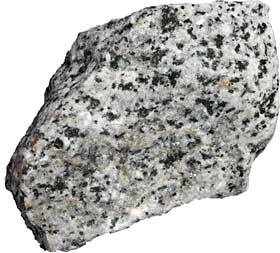 A: This is a picture of an igneous rock. You may construct a paragraph that answers the following questions, or you may answer each question individually.
- Why does this igneous rock have crystals?
- Where did this rock form? How do you know?
- What type of igneous rock is this?
B: This is a picture taken in the Badlands of South Dakota (there are other "badlands", too). The rocks that you see are sedimentary rocks, and they have NOT always been there. Use your knowledge of the rock cycle to answer this question: (If you need a refresher, view the rock cycle prezi in the blog post below this one.)
- How did these sedimentary rocks get here? (What are some of the events that could lead to the formation of sedimentary rocks?)
Rock Cycle
To review the rock cycle, navigate through this Rock Cycle Prezi, noting the three main types of rock and the processes by which they are formed.
Tuesday, November 17, 2009
Minerals
When you first heard that we would be learning about minerals, here were some of the initial comments:
- "So...... we're gonna learn about rocks....... OK......."
- "Are there really minerals in a bottle of mineral water?"
- "Diamonds, gold, and other gemstones are minerals. Can we keep the ones we work with?"
- "Aren't there minerals in the Fruity Pebbles I eat for breakfast?"
In your comment, completely answer the following questions. If you don't want your comment to be published, that is fine! Just let me know in the comment you leave.- Minerals are identified by their properties. What are some of the properties you used to distinguish one mineral from another? Why is it best to use more than just one or two of these properties?
- Did some of the properties "work" better than others? Which ones were the most effective? Which were the least effective? Explain.
- What was the most difficult part of identifying minerals?
The World's QR Code